The DiscreteDistribution class
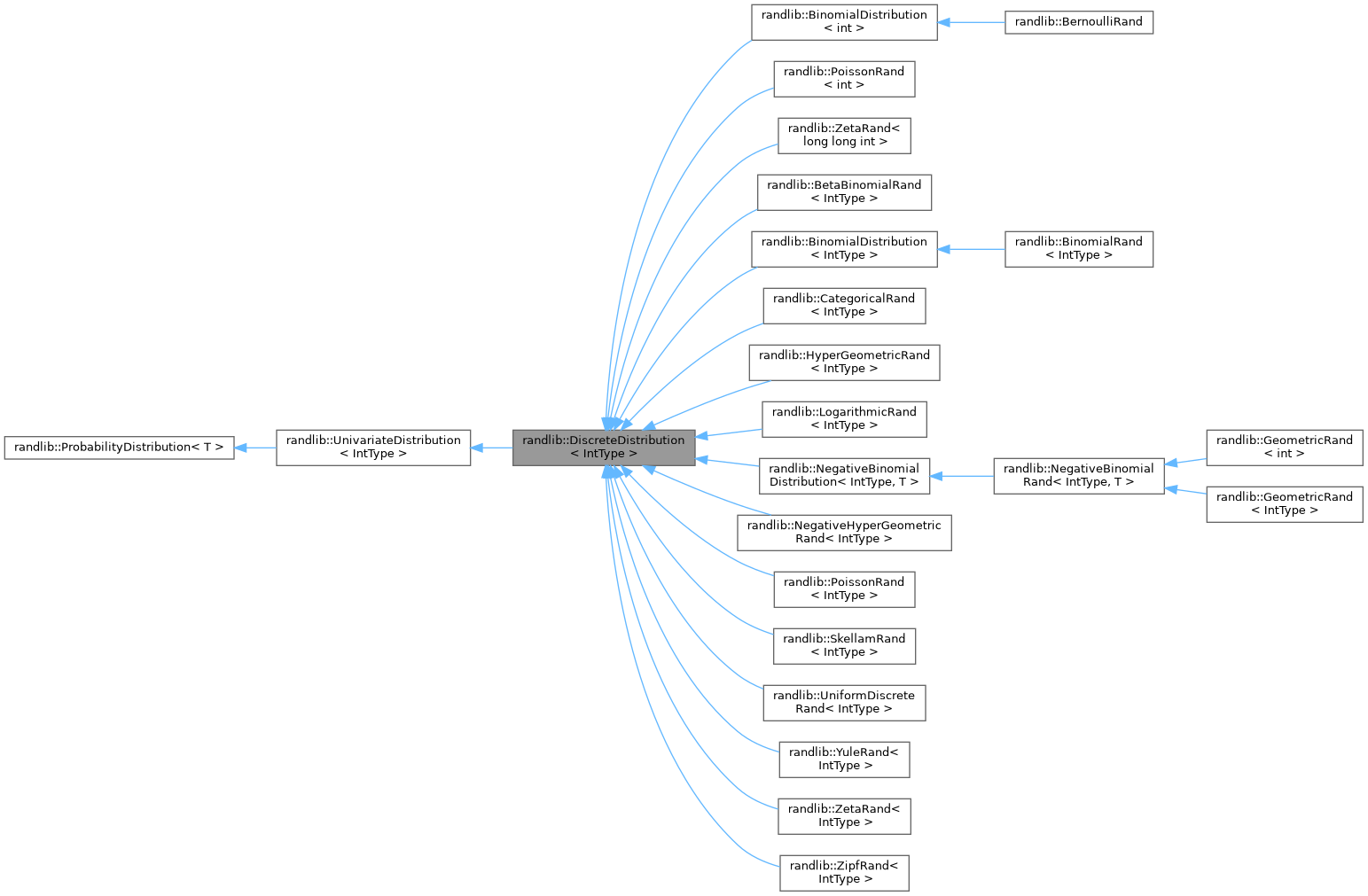
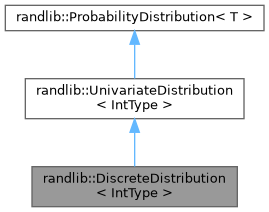
Abstract class for all discrete distributions.
More...
#include <discrete.hpp>
Public Member Functions | |
| virtual | ~DiscreteDistribution () |
| virtual double | P (const IntType &k) const |
| virtual double | logP (const IntType &x) const =0 |
| void | ProbabilityMassFunction (std::span< const IntType > x, std::span< double > y) const |
| fill vector y with P(x) | |
| void | LogProbabilityMassFunction (std::span< const IntType > x, std::span< double > y) const |
| fill vector y with logP(x) | |
| IntType | Mode () const override |
| Mode is the value, which has the largest probability to happen, or, in the case of continuous distribution, has the largest value of density function. | |
| double | Hazard (const IntType &x) const override |
| double | LikelihoodFunction (std::span< const IntType > sample) const override |
| double | LogLikelihoodFunction (std::span< const IntType > sample) const override |
| bool | PearsonChiSquaredTest (std::span< const IntType > orderStatistic, double alpha, int lowerBoundary, int upperBoundary, size_t numberOfEstimatedParameters=0) const |
| bool | PearsonChiSquaredTest (std::span< const IntType > orderStatistic, double alpha, size_t numberOfEstimatedParameters=0) const |
 Public Member Functions inherited from randlib::UnivariateDistribution< IntType > | |
| virtual | ~UnivariateDistribution () |
| virtual Support | SupportType () const=0 |
| bool | isLeftBounded () const |
| bool | isRightBounded () const |
| virtual long double | Mean () const=0 |
| virtual long double | Variance () const=0 |
| IntType | Quantile (double p) const |
| IntType | Quantile1m (double p) const |
| void | QuantileFunction (std::span< const double > p, std::span< IntType > y) const |
| void | QuantileFunction1m (std::span< const double > p, std::span< IntType > y) const |
| std::complex< double > | CF (double t) const |
| void | CharacteristicFunction (std::span< const double > t, std::span< std::complex< double > > y) const |
| void | HazardFunction (std::span< const IntType > x, std::span< double > y) const |
| virtual IntType | Median () const |
| virtual long double | Skewness () const |
| virtual long double | Kurtosis () const |
| virtual long double | ExcessKurtosis () const |
| virtual long double | SecondMoment () const |
| virtual long double | ThirdMoment () const |
| virtual long double | FourthMoment () const |
| Public Member Functions inherited from randlib::ProbabilityDistribution< T > | |
| virtual | ~ProbabilityDistribution ()=default |
| virtual std::string | Name () const =0 |
| virtual T | MinValue () const =0 |
| virtual T | MaxValue () const =0 |
| virtual double | F (const T &x) const =0 |
| void | CumulativeDistributionFunction (std::span< const T > x, std::span< double > y) const |
| virtual double | S (const T &x) const |
| void | SurvivalFunction (std::span< const T > x, std::span< double > y) const |
| template<std::uniform_random_bit_generator G> | |
| T | operator() (G &g) const |
| Draws a variate with the given engine through the virtual interface. | |
| T | Variate () const |
| Uses the engine of this object, so it is not thread-safe for one object; use operator() with one engine per thread instead. | |
| void | Sample (std::span< T > outputData) const |
| Fills the output with variates drawn with the engine of this object. | |
| template<std::uniform_random_bit_generator G> | |
| void | Sample (G &g, std::span< T > outputData) const |
| Fills the output with variates drawn with the given engine. | |
| void | Reseed (std::uint64_t seed) |
Protected Member Functions | |
| DiscreteDistribution () | |
| IntType | quantileImpl (double p, IntType initValue) const override |
| IntType | quantileImpl (double p) const override |
| IntType | quantileImpl1m (double p, IntType initValue) const override |
| IntType | quantileImpl1m (double p) const override |
| long double | ExpectedValue (const std::function< double(IntType)> &funPtr, IntType minPoint, IntType maxPoint) const override |
| std::complex< double > | CFImpl (double t) const override |
| Protected Member Functions inherited from randlib::UnivariateDistribution< IntType > | |
| UnivariateDistribution () | |
| Protected Member Functions inherited from randlib::ProbabilityDistribution< T > | |
| std::string | toStringWithPrecision (const double a_value, const int n=6) const |
| ProbabilityDistribution ()=default | |
| DefaultEngine & | engine () const |
| virtual T | variate (detail::EngineRef g) const =0 |
| Every concrete distribution implements this by calling its templated operator() | |
| virtual void | sample (detail::EngineRef g, std::span< T > outputData) const |
| Fills the output with variate(g); distributions with a faster bulk algorithm override it. | |
| fit_error | fitError (FitErrorCode code, const std::string &explanation) const |
Additional Inherited Members | |
| Public Types inherited from randlib::ProbabilityDistribution< T > | |
| using | value_type = T |
| Static Public Member Functions inherited from randlib::UnivariateDistribution< IntType > | |
| static long double | GetSampleSum (std::span< const IntType > sample) |
| static long double | GetSampleMean (std::span< const IntType > sample) |
| static long double | GetSampleLogMean (std::span< const IntType > sample) |
| static long double | GetSampleVariance (std::span< const IntType > sample, double mean) |
| static long double | GetSampleLogVariance (std::span< const IntType > sample, double logMean) |
| static LongDoublePair | GetSampleMeanAndVariance (std::span< const IntType > sample) |
| static LongDoublePair | GetSampleLogMeanAndVariance (std::span< const IntType > sample) |
| static std::tuple< long double, long double, long double, long double > | GetSampleStatistics (std::span< const IntType > sample) |
| Static Protected Member Functions inherited from randlib::UnivariateDistribution< IntType > | |
| static bool | allElementsAreNotGreaterThan (IntType value, std::span< const IntType > sample) |
| static bool | allElementsAreNotSmallerThan (IntType value, std::span< const IntType > sample) |
| static bool | allElementsAreNonNegative (std::span< const IntType > sample) |
| static bool | allElementsArePositive (std::span< const IntType > sample) |
| Static Protected Attributes inherited from randlib::ProbabilityDistribution< T > | |
| static constexpr size_t | MAX_ITER_REJECTION = detail::MAX_ITER_REJECTION |
| MAX_ITER_REJECTION upper boundary for maximum amount of iterations in rejection methods one thousand should be enough to be sure there is a bug (or rejection method is too slow to be used) | |
| static constexpr char | POSITIVITY_VIOLATION [] = "All elements should be positive" |
| static constexpr char | NON_NEGATIVITY_VIOLATION [] = "All elements should be non-negative" |
| static constexpr char | UPPER_LIMIT_VIOLATION [] = "No element should be greater than " |
| static constexpr char | LOWER_LIMIT_VIOLATION [] = "No element should be smaller than " |
Detailed Description
class randlib::DiscreteDistribution< IntType >
The DiscreteDistribution class
Abstract class for all discrete distributions.
Constructor & Destructor Documentation
◆ DiscreteDistribution()
|
inlineprotected |
◆ ~DiscreteDistribution()
|
inlinevirtual |
Member Function Documentation
◆ CFImpl()
|
overrideprotectedvirtual |
- Parameters
-
t
- Returns
- characteristic function implementation (inverse Fourier transform of pdf)
Σ P(k) e^{itk}, summed outwards from the median. Beyond the last term K of a walk with ratio r = e^{±it}, the remainder Σ_{m≥1} P(K + m) r^{K+m} is replaced by the first terms of Euler's transformation r^{K+1} / (1 - r) Σ_j (r / (1 - r))^j Δ^j P(K + 1), with forward differences Δ along the walk. The walk stops once the next term of that series is negligible or the remaining mass is; summing until P(k) itself vanishes would take ~10^10 terms for Zeta(2)
Reimplemented from randlib::UnivariateDistribution< IntType >.
◆ ExpectedValue()
|
overrideprotectedvirtual |
- Parameters
-
funPtr pointer on function g(x) with finite support which expected value should be returned minPoint min{x | g(x) ≠ 0} maxPoint max{x | g(x) ≠ 0}
- Returns
- E[g(x)]
Implements randlib::UnivariateDistribution< IntType >.
◆ Hazard()
|
overridevirtual |
◆ LikelihoodFunction()
|
overridevirtual |
- Parameters
-
sample
- Returns
- likelihood function of the distribution for given sample
Implements randlib::UnivariateDistribution< IntType >.
Reimplemented in randlib::UniformDiscreteRand< IntType >.
◆ LogLikelihoodFunction()
|
overridevirtual |
- Parameters
-
sample
- Returns
- log-likelihood function of the distribution for given sample
Implements randlib::UnivariateDistribution< IntType >.
Reimplemented in randlib::UniformDiscreteRand< IntType >.
◆ logP()
|
pure virtual |
- Parameters
-
x
- Returns
- logarithm of probability to get x
Implemented in randlib::BinomialDistribution< int >, randlib::GeometricRand< int >, randlib::PoissonRand< int >, randlib::RademacherRand, randlib::BetaBinomialRand< IntType >, randlib::BinomialDistribution< IntType >, randlib::CategoricalRand< IntType >, randlib::GeometricRand< IntType >, randlib::HyperGeometricRand< IntType >, randlib::LogarithmicRand< IntType >, randlib::NegativeBinomialDistribution< IntType, T >, randlib::NegativeHyperGeometricRand< IntType >, randlib::PoissonRand< IntType >, randlib::SkellamRand< IntType >, randlib::UniformDiscreteRand< IntType >, randlib::YuleRand< IntType >, randlib::ZetaRand< IntType >, randlib::ZipfRand< IntType >, and randlib::ZetaRand< long long int >.
◆ LogProbabilityMassFunction()
| void randlib::DiscreteDistribution< IntType >::LogProbabilityMassFunction | ( | std::span< const IntType > | x, |
| std::span< double > | y | ||
| ) | const |
fill vector y with logP(x)
- Parameters
-
x y
◆ Mode()
|
overridevirtual |
Mode is the value, which has the largest probability to happen, or, in the case of continuous distribution, has the largest value of density function.
- Returns
- mode. In case, when it's not unique, return any of them.
Works only for unimodal distributions
Implements randlib::UnivariateDistribution< IntType >.
Reimplemented in randlib::HyperGeometricRand< IntType >, randlib::LogarithmicRand< IntType >, randlib::NegativeBinomialDistribution< IntType, T >, randlib::PoissonRand< IntType >, randlib::PoissonRand< int >, randlib::RademacherRand, randlib::SkellamRand< IntType >, randlib::UniformDiscreteRand< IntType >, randlib::YuleRand< IntType >, randlib::ZetaRand< IntType >, randlib::ZetaRand< long long int >, and randlib::ZipfRand< IntType >.
◆ P()
|
inlinevirtual |
- Parameters
-
k
- Returns
- probability to get k
Reimplemented in randlib::BinomialDistribution< int >, randlib::GeometricRand< int >, randlib::RademacherRand, randlib::BetaBinomialRand< IntType >, randlib::BinomialDistribution< IntType >, randlib::CategoricalRand< IntType >, randlib::GeometricRand< IntType >, randlib::HyperGeometricRand< IntType >, randlib::LogarithmicRand< IntType >, randlib::NegativeBinomialDistribution< IntType, T >, randlib::NegativeHyperGeometricRand< IntType >, randlib::SkellamRand< IntType >, randlib::UniformDiscreteRand< IntType >, and randlib::ZipfRand< IntType >.
◆ PearsonChiSquaredTest() [1/2]
| bool randlib::DiscreteDistribution< IntType >::PearsonChiSquaredTest | ( | std::span< const IntType > | orderStatistic, |
| double | alpha, | ||
| int | lowerBoundary, | ||
| int | upperBoundary, | ||
| size_t | numberOfEstimatedParameters = 0 |
||
| ) | const |
- Parameters
-
orderStatistic sample sorted in ascending order alpha significance level of the test lowerBoundary setting of the left most interval (-infinity, lowerBoundary] upperBoundary setting of the right most interval [upperBoundary, infinity) numberOfEstimatedParameters zero by default
- Returns
- true if sample is from this distribution according to Pearson's chi-squared test, false otherwise
Chi-squared test is implemented only for discrete distribution, as it is much more complicated for continuous one. The problem is ambiguity of grouping sample into intervals. In the case when parameters are estimated by maximum-likelihood estimator, using original observations, statistics might not follow asymptotic chi-square distribution and that leads to serious underestimate of the error of the first kind. For more details look: "The use of MLE in chi-square tests for goodness of fit" by Herman Chernoff and E.L. Lehmann
Sanity checks
Cells are (-∞, lower], every value in (lower, upper], including unobserved ones, and (upper, ∞). A boundary at the end of the support is replaced by the extreme observation, so the tails beyond the sample are grouped into one cell each. An unobserved value contributes its probability to the sum, so those cells are accounted for together
◆ PearsonChiSquaredTest() [2/2]
| bool randlib::DiscreteDistribution< IntType >::PearsonChiSquaredTest | ( | std::span< const IntType > | orderStatistic, |
| double | alpha, | ||
| size_t | numberOfEstimatedParameters = 0 |
||
| ) | const |
- Parameters
-
orderStatistic sample sorted in ascending order alpha significance level of the test numberOfEstimatedParameters zero by default
- Returns
- true if sample is from this distribution according to Pearson's chi-squared test, false otherwise In this function user won't set upper and lower intervals for tails. However it might be useful to group rare events for chi-squared test to achieve better results
◆ ProbabilityMassFunction()
| void randlib::DiscreteDistribution< IntType >::ProbabilityMassFunction | ( | std::span< const IntType > | x, |
| std::span< double > | y | ||
| ) | const |
fill vector y with P(x)
- Parameters
-
x y
◆ quantileImpl() [1/2]
|
overrideprotectedvirtual |
Implements randlib::UnivariateDistribution< IntType >.
◆ quantileImpl() [2/2]
|
overrideprotectedvirtual |
- Parameters
-
p initValue initial value of x
- Returns
- such x that F(x) = p
go up
go down
if lower quantile is not equal probability, we return upper quantile
Implements randlib::UnivariateDistribution< IntType >.
◆ quantileImpl1m() [1/2]
|
overrideprotectedvirtual |
Implements randlib::UnivariateDistribution< IntType >.
◆ quantileImpl1m() [2/2]
|
overrideprotectedvirtual |
- Parameters
-
p initValue initial value of x
- Returns
- such x that F(x) = 1 - p
go up
go down
if lower quantile is not equal probability, we return upper quantile
Implements randlib::UnivariateDistribution< IntType >.
The documentation for this class was generated from the following file: